World’s deepest banner protest, world record set by Greenpeace
Norwegian Sea, Arctic — While conducting a scientific survey of vulnerable and unexplored deep-sea ecosystems along the Arctic Mid-Ocean Ridge, Greenpeace deployed an underwater robot from 2,300 meters below the surface, setting the world record for the deepest banner protest ever made, according to the WORLD RECORD ACADEMY.
Photo: Banner image of ROV expedition led by Greenpeace International, Greenpeace Germany and Greenpeace Nordic. The ROV deploys an underwater robot and banner reading ‘Listen To The Science’ 2,300 meters below the surface near Loki’s Castle in the Arctic Ocean.
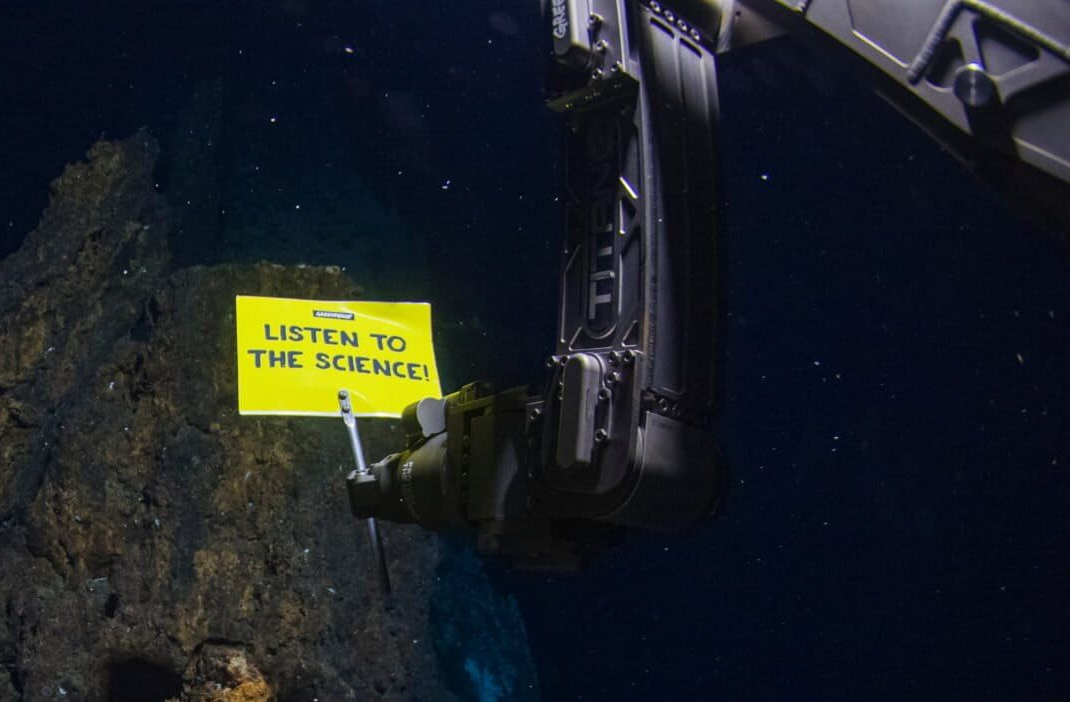
"Norwegian Sea, Arctic — Norwegian Sea, Arctic — While conducting a scientific survey of vulnerable and unexplored deep-sea ecosystems along the Arctic Mid-Ocean Ridge, Greenpeace deployed an underwater robot from 2,300 meters below the surface, in the deepest banner protest ever made from the seabed demanding global leaders: LISTEN TO THE SCIENCE!
"The banner was brought down to 2315 metres below sea level by the expedition’s remotely operated vehicle – ROV Holly – and held up in front of the hydrothermal vent field called “Loki’s Castle”, a unique volcanic ecosystem where black smokers are emitting 300–320 °C fluid from deep within the ocean crust," the Greenpeace says.
: Scientists believe our own distant ancestors may have looked just like the microbes living on structures like these, making Loki’s Castle a “cradle” of complex life that could hold the key to how life on Earth once started."
"Dr. Sandra Schöttner, Chief Scientist for the Deep Arctic Expedition, Greenpeace International said: “This marks the deepest banner protest in history, to speak for ecosystems that have no voice of their own. World leaders have already promised to protect 30 percent of the oceans, now they must listen to the science and actually do it. We cannot meet our global goals if we also allow industrial exploitation of unexplored and vulnerable ecosystems in the deep sea. It is high time that leaders keep their promises and give the oceans a chance to recover.”
Dr. Sandra Schöttner said: “It is not too late to act. Science clearly predicts the limits of what our planet can endure, but human action determines our survival. By safeguarding these deep-sea ecosystems within a global network of ocean sanctuaries and establishing a moratorium on deep sea mining, we can create a resilient safety net for marine life, and protect the health of our global oceans for generations to come," the Greenpeace says.
"The Arctic is one of the most rapidly changing regions on Earth due to climate change, and as the industrial frontier expands toward the deep sea, through threats like deep-sea mining, Greenpeace warns that these unique ‘biodiversity hotspots’ are at risk of irreversible disruption ," the Greenpeace says.
"The Deep Arctic Expedition brings together world-leading scientists to explore Arctic seamounts and hydrothermal vent fields – all while live streaming the science from the Arctic seabed on Greenpeace International’s YouTube channel. The area of the expedition was opened for deep sea mining by the Norwegian government in 2024, but the plans were halted last year after protests from environmental organisations, fishermen, scientists and the green opposition parties in Norway.
" Deep sea mining would, according to many scientists, cause irreversible damage to vulnerable deep-sea ecosystems, including the destruction of habitats, and possibly species extinction.."
"Greenpeace is a global campaigning network, founded in Canada in 1971 by a group of environmental activists. Greenpeace states its goal is to "ensure the ability of the Earth to nurture life in all its diversity", and focuses its campaigning on worldwide issues such as climate change, deforestation, overfishing, commercial whaling, genetic engineering, anti-war,[4] and anti-nuclear issues. It uses direct action, advocacy, research, and ecotage[6] to achieve its goals. (Wikipedia)
"The network comprises 26 independent national/regional organizations in over 55 countries across Europe, the Americas, Africa, Asia, Australia and the Pacific, as well as a coordinating body, Greenpeace International, based in Amsterdam, Netherlands."
"The global network does not accept funding from governments, corporations, or political parties, relying on three million individual supporters and foundation grants.[8][9] Greenpeace has a general consultative status with the United Nations Economic and Social Council and is a founding member of the INGO Accountability Charter, an international non-governmental organization that intends to foster accountability and transparency of non-governmental organizations.
"Deep below the ocean surface, at roughly the depth of 130 five-story buildings stacked end to end, a robot has unfurled a protest sign that reads: “LISTEN TO THE SCIENCE!”
"A Greenpeace remotely operated vehicle (ROV) holds the banner more than 2,300 meters (7,500 feet) below the surface of the Norwegian Sea, in front of a hydrothermal vent field known as Loki’s Castle,"
Monga Bay reports.
“This marks the deepest banner protest in history, to speak for ecosystems that have no voice of their own,” Schöttner, chief scientist for the Deep Arctic Expedition, Greenpeace International, said in a press release.
"The Norwegian Sea is a marginal sea, grouped with either the Atlantic Ocean or the Arctic Ocean, northwest of Norway between the North Sea and the Greenland Sea, adjoining the Barents Sea to the northeast. In the southwest, it is separated from the Atlantic Ocean by a submarine ridge running between Iceland and the Faroe Islands. To the north, the Jan Mayen Ridge separates it from the Greenland Sea. (Wikipedia)
"Unlike many other seas, most of the bottom of the Norwegian Sea is not part of a continental shelf and therefore lies at a great depth of about two kilometres (1.2 miles) on average. Rich deposits of oil and natural gas are found under the sea bottom and are being explored commercially, in the areas with sea depths of up to about one kilometre (0.6 miles). The coastal zones are rich in fish that visit the Norwegian Sea from the North Atlantic or Barents Sea (cod) for spawning."
Related world records: